

When liposomal bupivacaine (LB) was FDA-approved in 2011, it was based on local infiltration and nerve block trials comparing it to placebo, not to standard bupivacaine (SB). I’d love to stop writing this piece right here. In what world of medicine is it acceptable to compare a new version of a drug to placebo rather than its counterpart?
The supposed benefit of LB is that its encapsulated form slows drug clearance, thus increasing its analgesic duration of action. LB has an initial time to peak plasma concentration of 1 hour, with a second peak at 12–36 hours. Systemic plasma levels can persist for 96–168 hours depending on the site and route of administration. However, these long durations do not indicate its duration of analgesia.1
Some studies have shown a longer sensory block with LB, while some studies have shown LB to be inferior to SB. However, the majority of studies have shown no significant difference or no clinically meaningful difference between LB and SB in terms of pain scores and opioid consumption at various time points. Most studies showing a clinically significant benefit from LB have either been placebo-controlled, at high risk for bias, or both.2
For example, a 2021 review by Ilfeld and colleagues found that “only 11% of trials (4 of 36) reported a clinically relevant and statistically significant improvement in the primary outcome favoring liposomal bupivacaine” when LB was used for surgical infiltration. The trials looking at nerve blocks for knee and shoulder surgeries generally found that both single-shot and continuous blocks with SB provided superior analgesia compared with LB. Studies at high risk for bias (25%, 19/77) were more likely to report statistically significant results (84% of the 19 studies).3
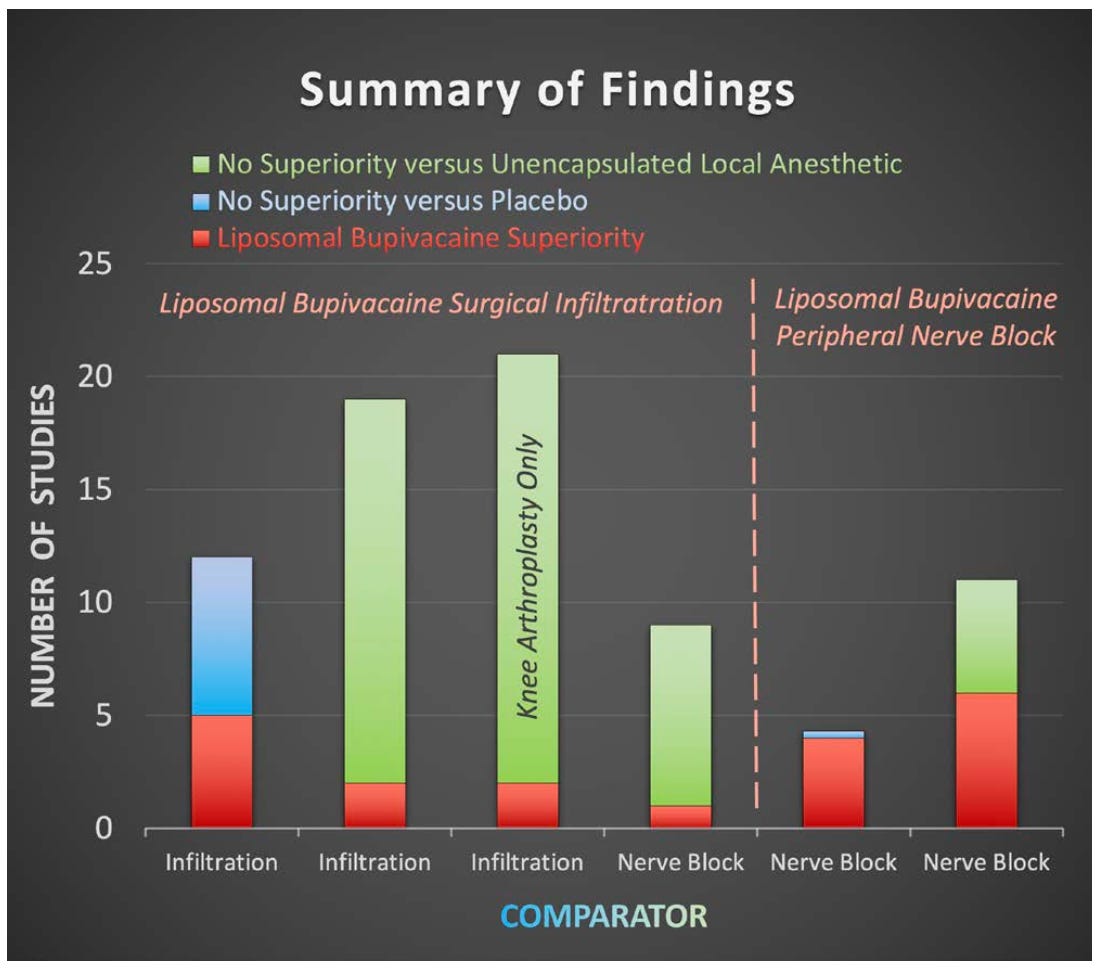
A 2021 meta-analysis had similar conclusions, noting that 74.58% of the included studies failed to show significant benefits from LB. Furthermore, 83.33% of the included trials showed that LB failed to reduce opioid consumption when compared with SB. The authors noted that clinical trials with financial conflicts of interest were far more likely to show decreased opioid consumption (odds ratio [OR], 12.35; 95% confidence interval [CI], 1.40–109.07; p = 0.0237).
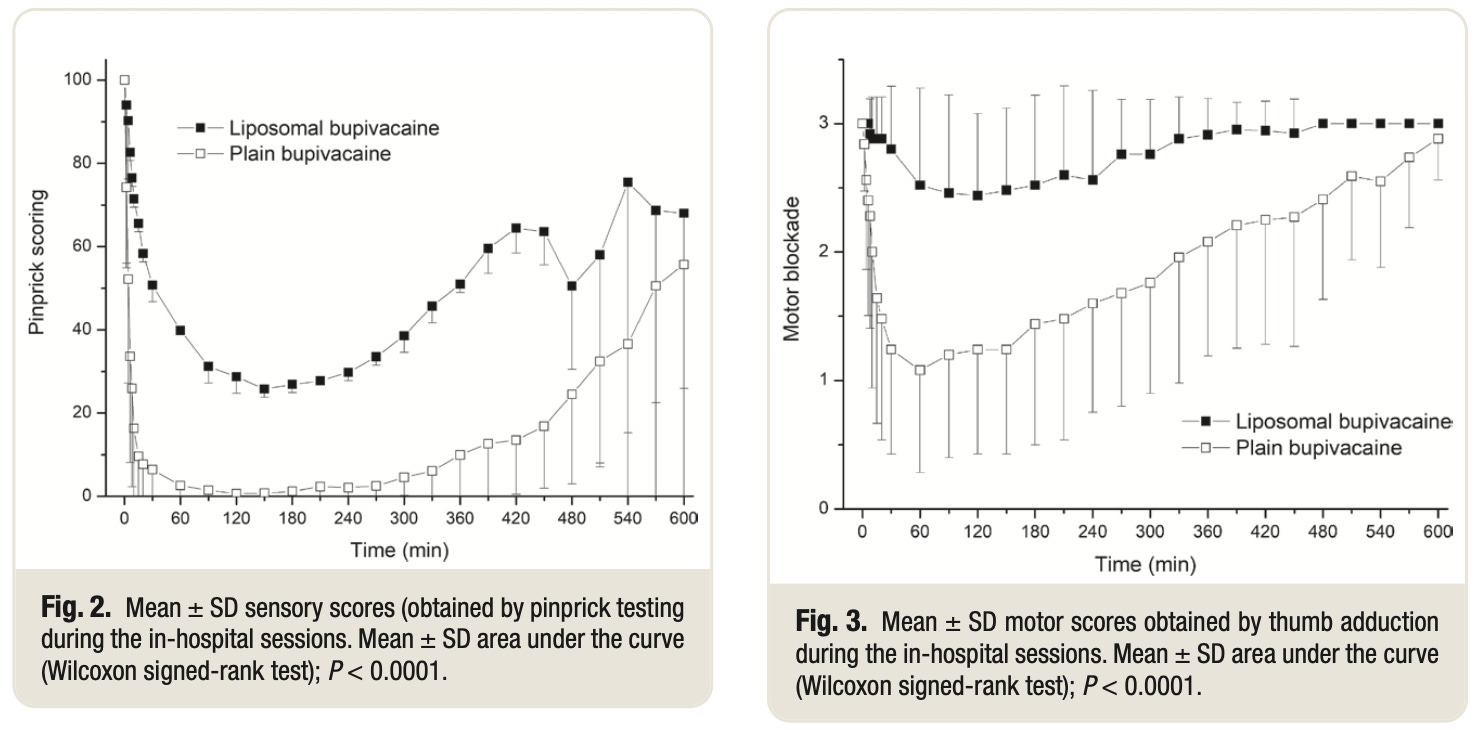
An example of LB being inferior to SB comes from a crossover study comparing LB to SB in ulnar nerve blocks. When participants were given LB, only 32% (8/25) had an adequate block, compared with 100% when SB was administered. Due to its pharmacokinetics, LB has been noted to have a longer onset of action. This may play a role in its lack of superior efficacy.
To hasten its onset, it became permissible to mix SB with LB in a ratio of up to 1:2. For example, one can administer 50 mg of SB alongside 100 mg of LB. It is recommended to avoid other local anesthetics for 96 hours following LB administration. Administration of a non-bupivacaine local anesthetic could theoretically cause accelerated release of bupivacaine from its encapsulated form, leading to local anesthetic systemic toxicity (LAST). One could argue that these factors increase the risk of medication errors.
High cost with no reward
Perhaps the biggest downside is the cost. Liposomal bupivacaine offers no improvement in analgesia at a cost that is an order of magnitude more. The cost per vial of SB is estimated at $5 or less, whereas the cost of LB is estimated at $200 or more.
There are numerous trials investigating LB making it easy to cherry-pick the few that have shown benefits. However, the majority of the evidence shows no difference in analgesia compared with standard bupivacaine. Combined with the high cost and potential for increased drug interactions, I find no compelling reason to use liposomal bupivacaine.
Liposomal bupivacaine could be a case study on the importance of appropriately designed clinical trials. If the FDA had demanded a comparison with an active comparator (e.g. bupivacaine or ropivacaine) rather than a placebo, you would not be reading this. Meanwhile, 15 years after this drug’s approval, a pharmaceutical company continues to woo clinicians with claims of longer-lasting pain control.
This may be because the LB does not remain at the site of injection, but whether this is the case does not appear to have been studied in humans.
Cochrane Reviews on this topic included fewer trials, likely due to their earlier publication dates. A 2017 Cochrane review concluded that “the limited evidence does not demonstrate [LB] superiority to bupivacaine hydrochloride,” and noted that all included studies were “funded or published by Pacira Pharmaceuticals Incorporated, manufacturer of liposomal bupivacaine.”
This is a long article and it is difficult to capture all of its points without also making this post very long. I encourage anyone interested in this topic to give it a read.
Such a helpful roundup, Tyler! And the 96-hour window to avoid other local anesthetics afterward is so easy to miss.